

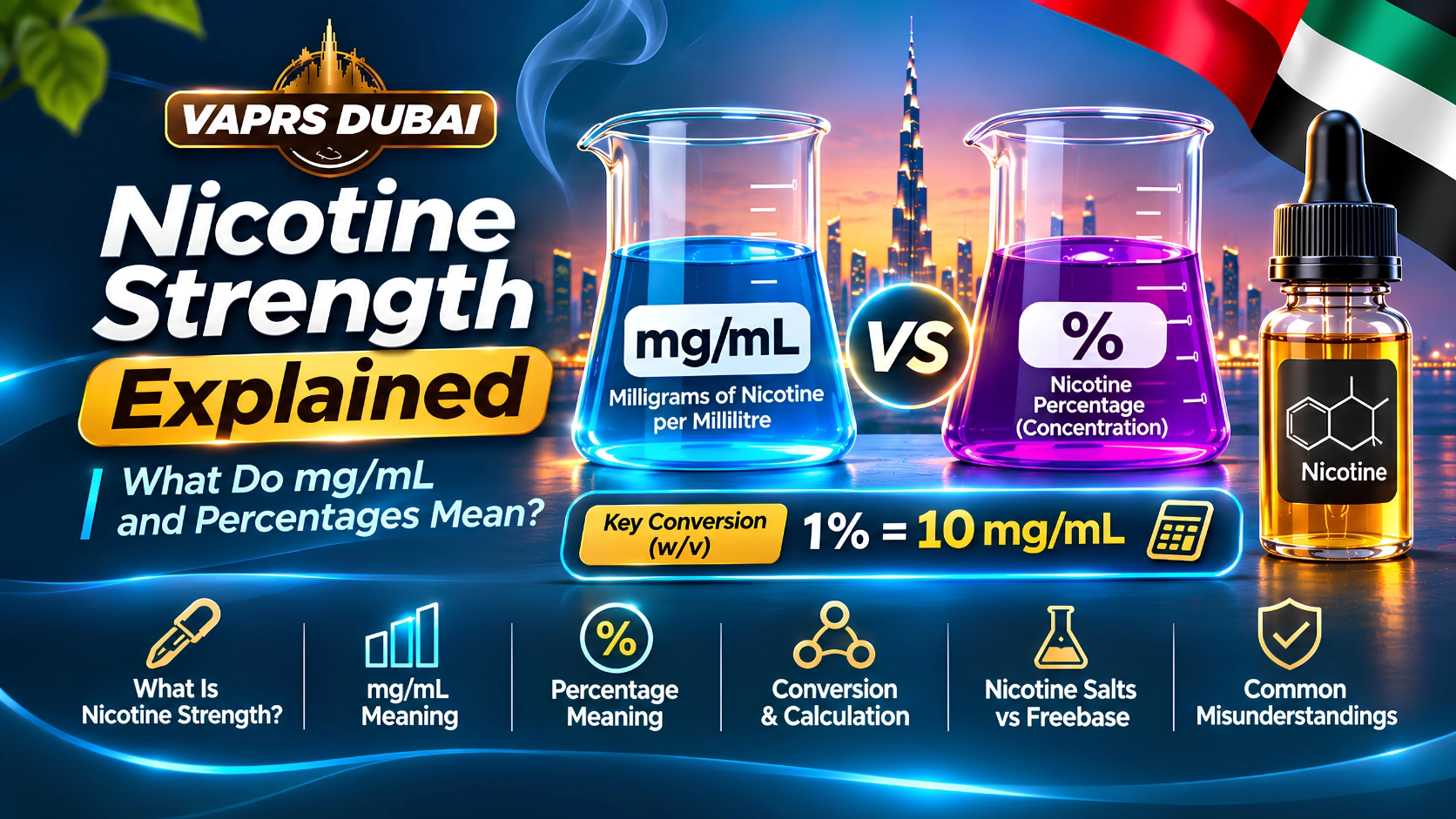
Understanding Nicotine Strength – What Do mg/mL and Percentages Mean? Leave a comment
Nicotine Strength Explained: What Do mg/mL and Percentages Mean?
Nicotine strength explained in simple terms can help readers understand the measurements printed on nicotine-containing product labels. Two commonly used expressions are milligrams per millilitre (mg/mL) and percentage (%). Although both can describe nicotine concentration, they are not always interchangeable without understanding how the percentage is calculated.
Understanding nicotine strength is important when interpreting technical product information, comparing label measurements or reading health and safety information.
This guide explains what nicotine concentration means, how mg/mL and percentages relate, how to calculate the total nicotine content in a liquid and why concentration is different from the amount absorbed by the human body.
It also explains nicotine salts, freebase nicotine, labelling considerations and common misunderstandings surrounding nicotine measurements.
Health information notice: This article is educational and non-promotional. Nicotine is addictive. The information does not recommend nicotine use, a particular concentration or a nicotine-containing product. It is not a substitute for professional medical advice.
1. What Is Nicotine Strength?
Nicotine strength generally refers to the concentration of nicotine in a particular product or liquid.
For electronic cigarette liquids, concentration is commonly expressed in milligrams per millilitre (mg/mL). Some labels also display nicotine concentration as a percentage.
These measurements describe how much nicotine is present in a given quantity of liquid.
For example, a label showing 10 mg/mL indicates that each millilitre of the liquid contains 10 milligrams of nicotine, assuming the stated concentration is accurate.
The term nicotine strength should not be confused with:
- The total volume of liquid.
- The total nicotine content in a container.
- The amount of nicotine released as aerosol.
- The amount of nicotine absorbed by the body.
- The speed at which nicotine enters the bloodstream.
These are related measurements, but they describe different things.
2. What Does mg/mL Mean in Nicotine Concentration?
The abbreviation mg/mL means milligrams per millilitre.
It is a unit used to express the concentration of a substance within a liquid.
In nicotine-containing liquids:
- mg means milligrams.
- mL means millilitres.
- mg/mL describes the mass of nicotine present in each millilitre of liquid.
Consider these examples:
| Label Concentration | Meaning |
|---|---|
| 0 mg/mL | No nicotine concentration is declared |
| 3 mg/mL | 3 mg of nicotine per mL |
| 5 mg/mL | 5 mg of nicotine per mL |
| 10 mg/mL | 10 mg of nicotine per mL |
| 20 mg/mL | 20 mg of nicotine per mL |
These are mathematical examples, not product recommendations or statements about UAE legal limits.
The key point is that mg/mL describes concentration rather than the total quantity of nicotine in an entire container.
3. What Does Nicotine Percentage Mean?
Some product labels display nicotine concentration as a percentage instead of mg/mL.
A percentage describes a proportion, but the precise conversion depends on the measurement convention used.
For liquid nicotine labels, percentage may be expressed using weight per volume (w/v) or weight per weight (w/w).
These conventions are not identical.
Weight per Volume (w/v)
Weight per volume expresses the mass of nicotine in a specified volume of liquid.
Under this convention:
- 1% w/v means 1 gram of nicotine per 100 mL of liquid.
- 1 gram equals 1,000 milligrams.
- Therefore, 1% w/v equals 10 mg/mL.
This gives the following mathematical conversions:
| Percentage (w/v) | Equivalent Concentration |
|---|---|
| 0.1% | 1 mg/mL |
| 0.3% | 3 mg/mL |
| 0.5% | 5 mg/mL |
| 1% | 10 mg/mL |
| 1.5% | 15 mg/mL |
| 2% | 20 mg/mL |
Important: These conversions apply only when the percentage is expressed as weight per volume.
Weight per Weight (w/w)
Weight per weight expresses the mass of nicotine relative to the total mass of the liquid.
For example, a 1% w/w concentration means 1 gram of nicotine in every 100 grams of the mixture.
This cannot automatically be converted to 10 mg/mL without knowing the liquid’s density.
Therefore, when interpreting nicotine percentage, check the manufacturer’s stated measurement convention rather than assuming that every percentage label follows the same calculation.
4. Nicotine mg/mL vs Percentage: What Is the Difference?
Both measurements can describe nicotine concentration, but they express it differently.
| Measurement | What It Describes | Example |
|---|---|---|
| mg/mL | Milligrams of nicotine per millilitre of liquid | 10 mg/mL |
| Percentage (w/v) | Grams of nicotine per 100 mL of liquid | 1% w/v |
| Percentage (w/w) | Grams of nicotine per 100 grams of mixture | 1% w/w |
| Total nicotine content | Total mass of nicotine in a specified quantity | 100 mg in 10 mL |
The important distinction is the measurement basis.
A percentage label should not automatically be treated as a directly interchangeable mg/mL value unless the convention is known.
Clear labelling helps prevent misunderstandings when reading technical product information.
5. How to Calculate Total Nicotine Content in a Liquid
Nicotine concentration and total nicotine content are two different measurements.
Concentration describes the amount of nicotine per millilitre. Total content describes the amount present in the entire quantity of liquid.
The basic mathematical relationship is:
Total nicotine content (mg) = Concentration (mg/mL) × Liquid volume (mL)
For example, consider a hypothetical liquid with:
- Concentration: 10 mg/mL.
- Volume: 10 mL.
Calculation:
10 mg/mL × 10 mL = 100 mg.
The liquid therefore contains 100 mg of nicotine in total, assuming the stated concentration and volume are accurate.
Another mathematical example:
- Concentration: 5 mg/mL.
- Volume: 20 mL.
Calculation:
5 mg/mL × 20 mL = 100 mg.
Both examples contain the same calculated total nicotine content, but their concentrations are different.
These examples are provided only to explain measurement and should not be interpreted as product-use guidance.
6. Does Nicotine Concentration Equal the Amount Absorbed by the Body?
No. This is one of the most important distinctions in nicotine measurement.
A product label may state a nicotine concentration, but that figure does not tell us exactly how much nicotine enters the bloodstream.
The amount absorbed can depend on multiple factors, including:
- Product design.
- Nicotine formulation.
- Aerosol or delivery characteristics.
- Individual exposure patterns.
- Frequency and duration of exposure.
- Biological differences between individuals.
For example, a liquid containing a stated quantity of nicotine does not mean that the entire amount will be absorbed by the body.
Similarly, a nicotine concentration expressed in mg/mL cannot be directly converted into a specific absorbed dose per puff without additional validated measurements.
The Centers for Disease Control and Prevention’s scientific material explains that nicotine absorption differs between delivery methods and products.
Therefore, nicotine concentration, total nicotine content and absorbed nicotine dose should always be treated as separate concepts.
7. What Is the Difference Between Freebase Nicotine and Nicotine Salts?
Freebase nicotine and nicotine salts are two forms of nicotine used in some nicotine-containing liquids.
Although both contain nicotine, they differ in their chemical form and formulation.
Freebase Nicotine
Freebase nicotine refers to nicotine in its unprotonated form.
It is a form used in various nicotine-containing liquid formulations.
Its chemical properties can influence characteristics such as pH and the sensory properties of an aerosol.
Nicotine Salts
Nicotine salts are formed when nicotine is combined with an acid, creating a protonated form.
The formulation changes certain chemical characteristics, including pH.
The term nicotine salt does not mean that the product contains ordinary table salt.
Are Their Concentration Measurements Different?
Both freebase nicotine and nicotine salts can be described using mg/mL.
The concentration measurement refers to the stated quantity of nicotine, but the exact analytical and labelling convention should be checked.
The chemical form alone does not tell us the total amount absorbed by the body or establish that a product is safe.
8. What Does 0 mg/mL Nicotine Mean?
A label showing 0 mg/mL generally indicates that the product is declared to contain no nicotine.
However, a label declaration and a laboratory measurement are not necessarily the same thing.
Analytical testing may be required to establish the actual nicotine content of a product.
For example, Health Canada explains that its regulatory framework uses a defined analytical threshold when assessing products declared to be nicotine-free.
This illustrates why product declarations, testing methods and regulatory definitions should be considered separately.
A zero-nicotine declaration should not be interpreted as proof that an inhaled aerosol contains no potentially harmful substances.
9. Why Is Accurate Nicotine Labelling Important?
Accurate labelling helps people understand the composition and technical information associated with a product.
It also supports regulatory oversight, product identification and quality-control processes.
Depending on the applicable jurisdiction and product requirements, labels may contain information such as:
- Nicotine concentration.
- Liquid volume or product quantity.
- Ingredient information.
- Manufacturer or importer details.
- Batch identification.
- Relevant safety warnings.
- Storage or handling instructions.
The precise labelling requirements vary between countries and product categories.
In the UAE, electronic nicotine products are subject to applicable technical and regulatory requirements, including the UAE.S 5030:2018 standard. Businesses should consult the current official standard and competent authorities rather than assuming that a foreign labelling framework applies locally.
10. Common Misunderstandings About Nicotine Strength
Myth 1: 1% Always Means 10 mg/mL
Fact: This conversion applies to a weight-per-volume percentage. A weight-per-weight percentage requires additional information, such as density, for conversion.
Myth 2: mg/mL Shows the Total Nicotine in the Container
Fact: mg/mL measures concentration. Total nicotine content also depends on the volume of liquid.
Myth 3: Total Nicotine Content Equals the Amount Absorbed
Fact: Total content and absorbed dose are different measurements. Absorption depends on the delivery method and other factors.
Myth 4: Two Labels With the Same Percentage Always Represent the Same Concentration
Fact: The percentage convention and labelling method must be known before making that comparison.
Myth 5: Nicotine Salts and Freebase Nicotine Are Different Units of Measurement
Fact: They are different chemical forms. Both can be described using concentration measurements such as mg/mL.
Myth 6: A Zero-Nicotine Label Proves an Aerosol Is Harmless
Fact: The absence of declared nicotine does not establish that an aerosol contains no other potentially harmful substances.
11. Frequently Asked Questions About Nicotine Strength
What does nicotine strength mean?
Nicotine strength generally refers to the concentration of nicotine in a product or liquid. It is commonly expressed in mg/mL or as a percentage.
What does mg/mL mean on a nicotine label?
It means milligrams of nicotine per millilitre of liquid. For example, 10 mg/mL represents 10 milligrams of nicotine in each millilitre.
How do you convert nicotine percentage into mg/mL?
For a weight-per-volume percentage, multiply the percentage value by 10 to obtain mg/mL. For example, 1% w/v equals 10 mg/mL. This calculation does not automatically apply to weight-per-weight percentages.
Is 2% nicotine the same as 20 mg/mL?
It is equivalent when the percentage is expressed as weight per volume (w/v). Always check the labelling convention before treating the figures as equivalent.
How do you calculate total nicotine content?
Multiply the nicotine concentration in mg/mL by the liquid volume in mL. The result is the total stated nicotine content in milligrams.
Is nicotine concentration the same as absorbed nicotine?
No. Concentration describes the nicotine present per unit of liquid. Absorbed nicotine refers to the amount that actually enters the body.
What is the difference between nicotine salts and freebase nicotine?
They are different chemical forms of nicotine. Nicotine salts are protonated forms, while freebase nicotine is unprotonated. Both may be measured in mg/mL.
Does 0 mg/mL mean there are no harmful substances?
No. It refers to the declared nicotine concentration. Other ingredients or aerosol constituents may still present health concerns.
Does the same nicotine percentage mean the same mg/mL everywhere?
Not necessarily. It depends on whether the percentage is expressed as weight per volume, weight per weight or another defined convention.
Where can I find reliable information about nicotine concentration?
Consult the product’s official technical documentation, applicable regulatory labelling requirements and recognized public-health authorities. For UAE-related questions, consult the relevant UAE authorities and current technical standards.
12. Official References and Further Reading
The following sources provide scientific and regulatory information about nicotine concentration, product labelling and nicotine exposure.
- Health Canada – Guidance for Regulated Parties on Nicotine Concentration in Vaping Products
https://www.canada.ca/en/health-canada/services/smoking-tobacco/vaping/product-safety-regulation/guidance-regulated-parties-nicotine-concentration-vaping-products.html - National Academies of Sciences, Engineering, and Medicine – Public Health Consequences of E-Cigarettes
https://www.nationalacademies.org/read/24952/chapter/8 - New Zealand Ministry of Health – Packaging and Labelling Requirements for Vaping Products
https://www.health.govt.nz/regulation-legislation/vaping-herbal-smoking-and-smokeless-tobacco/requirements/packaging-and-labelling-requirements - Centers for Disease Control and Prevention – Nicotine Absorption and Delivery
https://www.ncbi.nlm.nih.gov/books/NBK53018/table/ch4.t4/ - UAE Ministry of Industry and Advanced Technology
https://moiat.gov.ae/
These sources have different geographic and regulatory scopes. Foreign regulatory limits should not be presented as UAE legal requirements.
13. Conclusion: Why Understanding Nicotine Strength Matters
Nicotine strength explained through mg/mL and percentage measurements helps readers understand technical product information more accurately.
The most important distinction is that concentration, total nicotine content and absorbed nicotine dose are not the same measurement.
A percentage conversion also depends on the measurement convention. A 1% weight-per-volume concentration equals 10 mg/mL, but a weight-per-weight percentage cannot be converted in the same way without additional information.
Understanding these differences helps prevent incorrect comparisons and misleading interpretations of nicotine labels.
For reliable information, consult recognized health authorities, official product documentation and the relevant UAE regulatory sources.
Health disclaimer: This article is provided for general educational purposes. Nicotine is addictive. It does not recommend nicotine use, a particular concentration or a product. Consult a qualified healthcare professional for personal health questions or concerns about nicotine dependence.