

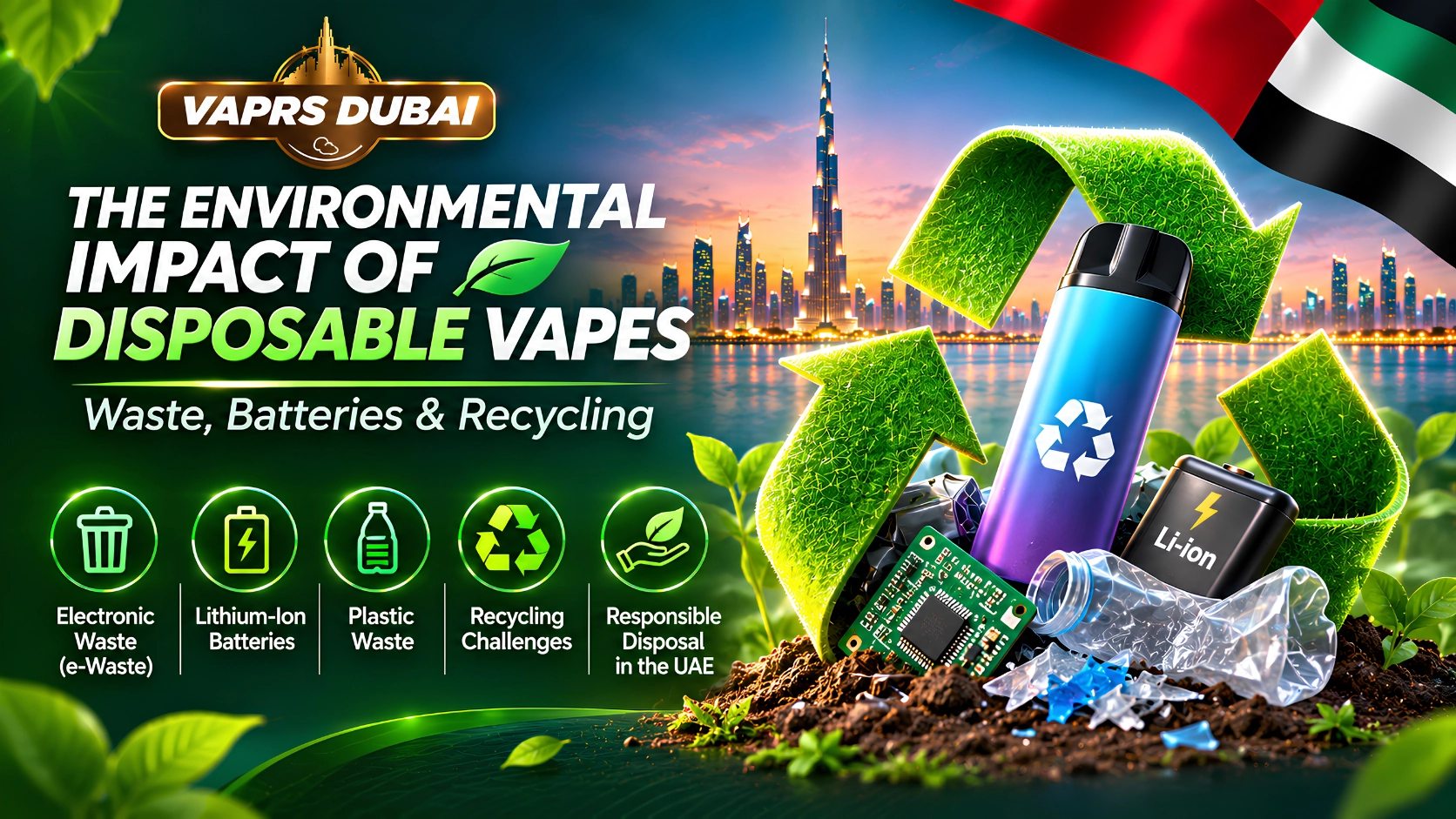
The Environmental Impact of Disposable Vapes – Waste, Batteries & Recycling Leave a comment
The Environmental Impact of Disposable Vapes: Waste, Batteries & Recycling
The environmental impact of disposable vapes is an increasingly important topic in discussions about electronic waste, plastic pollution and battery disposal. Unlike many ordinary consumer products, disposable electronic cigarettes combine several different materials in one compact device, including plastic, metal, electronic components and rechargeable or non-rechargeable lithium-based batteries.
When these devices are discarded without appropriate handling, their components can contribute to electronic waste, resource loss and potential environmental contamination.
Understanding the environmental impact of disposable vapes is important for anyone researching electronic waste, battery recycling, plastic pollution and responsible waste management in the United Arab Emirates (UAE).
This guide explains what disposable electronic cigarettes contain, why their disposal creates environmental challenges, how batteries and electronic components should be handled, and what UAE residents should understand about responsible electronic waste management.
Environmental information notice: This article is educational. It does not provide product recommendations or claim that any particular disposal method is accepted by every UAE municipality. Always follow the instructions of the relevant local waste-management authority.
1. What Is the Environmental Impact of Disposable Vapes?
The environmental impact of disposable vapes refers to the effects that their production, use and disposal may have on natural resources, waste systems and the surrounding environment.
Disposable electronic cigarettes are composite electronic products. They may contain several materials that require different waste-management processes.
Common components include:
- Plastic or metal outer casing.
- Lithium-ion or lithium-polymer batteries.
- Electronic circuit boards.
- Metal heating components.
- Wiring and electrical connections.
- Synthetic materials.
- Remaining e-liquid.
- Paper, cardboard and plastic packaging.
The combination of these materials creates a waste-management challenge.
Unlike a simple plastic container, an electronic cigarette cannot necessarily be treated as ordinary household waste because it contains a battery and electronic components.
The environmental impact of disposable vapes therefore involves several connected issues: electronic waste, plastic waste, battery waste, material recovery and the safe handling of residual liquid.
2. Why Do Disposable Electronic Cigarettes Create Electronic Waste?
Electronic waste, commonly called e-waste, includes discarded electrical and electronic equipment and its components.
Disposable electronic cigarettes fall within the broader discussion of electronic waste because they contain electrical circuits, batteries and other electronic components.
The WHO Framework Convention on Tobacco Control identifies disposable electronic cigarettes as composite products containing materials such as plastic, metal, lithium batteries and chemical substances.
This combination makes their disposal more complicated than disposing of a single-material product.
Common electronic waste components
Electronic circuit boards
Circuit boards contain electrical components and metals. These materials may require specialist processing to recover useful resources.
Metal components
Small metal components may be recoverable through appropriate recycling processes.
Wiring and electrical connections
Wires and connections form part of the electronic assembly and should be handled through suitable e-waste collection systems.
Battery components
The battery contains stored energy and requires appropriate handling during collection, transportation and recycling.
The environmental impact of disposable vapes is therefore closely connected to the wider challenge of managing small electronic devices.
3. Plastic Waste From Disposable Vapes
Plastic is commonly used in the outer casing, mouthpiece and other components of disposable electronic cigarettes.
When plastic-containing devices are discarded incorrectly, they can contribute to litter and increase the amount of material entering general waste streams.
Plastic waste can create several environmental concerns:
- Persistent litter in public spaces.
- Additional pressure on waste-management systems.
- Loss of materials that might otherwise be recovered.
- Potential fragmentation into smaller plastic particles.
- Increased demand for virgin raw materials when recovered materials are not reused.
Why Is Separating Plastic Difficult?
Disposable electronic cigarettes are assembled from multiple materials.
Plastic parts may be connected to metal components, electronic circuits and batteries. Separating these materials requires suitable processing methods.
A device that appears to be mostly plastic may still contain important electrical and chemical components that should not be handled as ordinary plastic packaging.
For this reason, electronic cigarette waste should not automatically be placed in a general plastic recycling container.
4. Lithium-Ion Battery Waste and Environmental Concerns
One of the most important environmental issues associated with disposable electronic cigarettes is battery waste.
Many disposable electronic devices contain lithium-ion or lithium-polymer batteries.
These batteries contain materials that may be recoverable through appropriate recycling processes. However, their collection and handling require care.
Why Is Battery Disposal Important?
Discarded lithium-ion batteries can create problems when they are damaged, crushed, punctured or exposed to unsuitable conditions.
Potential concerns include:
- Short circuits.
- Overheating.
- Fire during waste collection or transportation.
- Release of hazardous substances during improper treatment.
- Loss of potentially recoverable materials.
Batteries should not be treated as ordinary plastic or paper waste.
Resource Recovery
Lithium-ion batteries may contain materials such as lithium, copper, aluminium and other battery-related substances.
Appropriate recycling processes can help recover certain materials and reduce reliance on newly extracted resources.
However, recovery depends on the battery design, condition, recycling technology and available processing facilities.
Not every component can necessarily be recovered from every discarded device.
5. What Happens to Disposable Vapes When They Are Thrown Away?
The environmental consequences depend on how discarded devices are collected, sorted, transported and processed.
When Devices Enter General Waste
If an electronic cigarette is mixed with ordinary household waste, its battery and electronic components may not be separated before further waste processing.
This can increase the risk of battery damage during collection, compaction and transportation.
It may also prevent useful materials from entering appropriate recovery systems.
When Devices Are Littered
Discarded devices in streets, parks, beaches and other public spaces contribute to visible waste pollution.
Rainwater and environmental conditions may affect discarded materials and any residual liquid.
Littered electronic waste also makes collection and sorting more difficult.
When Devices Enter Appropriate Recycling Streams
Suitable e-waste and battery-management systems can help separate materials and direct them toward appropriate treatment or recovery processes.
The availability and acceptance requirements of these systems vary by location.
The environmental impact of disposable vapes can therefore be influenced by the quality of waste collection and the availability of appropriate processing facilities.
6. Leftover E-Liquid and Environmental Concerns
A discarded electronic cigarette may contain some liquid remaining inside its reservoir or internal materials.
The exact composition depends on the product.
Improper disposal of residual liquid can create additional handling and environmental concerns.
For example:
- Liquid may leak from damaged devices.
- Residual substances may contaminate other waste.
- Improper disposal may expose waste handlers to unwanted contact.
- Liquid entering drains or water systems may create environmental concerns.
Do not pour leftover e-liquid into sinks, toilets, storm drains or outdoor environments.
Do not dismantle a device to remove residual liquid. Follow the relevant local waste authority’s instructions for handling the complete device.
7. Why Is Disposable Vape Recycling Difficult?
Recycling disposable electronic cigarettes presents several technical and logistical challenges.
Mixed Material Construction
A single device can contain plastic, metal, a battery, electronic circuitry and liquid residue.
Each material may require a different treatment process.
Small Product Size
Small devices can be more difficult to identify and separate in mixed waste streams.
Their size may also make collection and sorting less efficient.
Integrated Battery Design
In some products, the battery is built into the device and is not designed for ordinary consumer removal.
Attempting to dismantle such devices can create physical and electrical safety risks.
Collection Infrastructure
Appropriate collection facilities may not be equally accessible in every area.
The availability of e-waste and battery collection services depends on local waste-management arrangements.
Consumer Awareness
People may not recognize that an electronic cigarette contains a battery and electronic components.
As a result, devices may be discarded with ordinary household rubbish instead of being directed to an appropriate collection system.
8. Environmental Impact of Disposable Vapes Compared With Other Electronic Waste
Disposable electronic cigarettes share several waste-related characteristics with other small electronic devices.
| Waste Type | Common Materials | Main Waste Concern |
|---|---|---|
| Disposable electronic cigarettes | Plastic, metal, batteries and circuits | Mixed electronic waste |
| Smartphones | Glass, metals, batteries and circuits | Complex material separation |
| Power banks | Batteries, casing and circuits | Battery fire and disposal risks |
| Wireless earbuds | Batteries, plastics and electronics | Small integrated components |
| Portable chargers | Batteries, plastics and metals | Battery waste and resource recovery |
The comparison shows that electronic cigarette waste is part of a wider electronic waste-management challenge.
The presence of a battery and electronic components means that disposal should be considered carefully, even when the device is small.
9. Environmental Impact of Disposable Vapes in the UAE
The environmental impact of disposable vapes is relevant to the UAE because waste management, recycling, plastic reduction and environmental protection are important parts of the country’s environmental framework.
The UAE Government describes national waste-management efforts involving waste separation, recycling, waste-to-energy projects and the management of hazardous waste.
However, waste collection and disposal arrangements are coordinated through relevant local authorities.
This means residents should check the rules and collection arrangements applicable to their own emirate.
UAE Federal Waste Management Framework
Federal Law No. 12 of 2018 concerning Integrated Waste Management provides a federal framework for waste management.
It addresses the management of waste, including relevant requirements for segregation, treatment, reduction and disposal.
Dubai Waste Management Law
Dubai has additional local waste-management legislation.
Law No. 18 of 2024 Regulating Waste Management in the Emirate of Dubai establishes requirements for waste management within Dubai.
The law includes provisions concerning waste segregation, sorting, collection, recycling and disposal.
Administrative Resolution No. 34 of 2026 provides the implementing bylaw for that Dubai law.
These are Dubai-specific legal instruments and should not be described as identical rules for every emirate.
What Does This Mean for Electronic Cigarette Waste?
Residents and businesses should not assume that a discarded electronic cigarette can automatically be placed in an ordinary recycling bin.
The appropriate route depends on how the relevant local authority classifies the waste and which collection facilities accept batteries and small electronic devices.
Where the correct disposal route is unclear, contact the municipality or an authorized waste-management provider.
10. How to Dispose of Disposable Electronic Cigarettes Responsibly
Responsible disposal begins with recognizing that an electronic cigarette is an electronic device containing a battery, rather than ordinary plastic waste.
The following general principles can help reduce avoidable risks.
Do Not Place Devices in Ordinary Plastic Recycling Bins
A disposable electronic cigarette contains materials beyond plastic.
Its battery and electrical components may require separate collection and treatment.
Do Not Put Devices in General Household Waste Without Checking Local Instructions
Check whether the relevant municipality or authorized provider has a designated e-waste or battery collection route.
Do not assume that every collection point accepts electronic cigarettes.
Do Not Dismantle the Device
Opening, crushing, puncturing or cutting a device may damage its battery or expose residual liquid.
Keep the device intact unless an authorized professional or approved collection process instructs otherwise.
Do Not Burn or Bury Electronic Devices
Burning or burying electronic waste can create environmental and safety hazards.
Use an approved waste-management route.
Do Not Pour Remaining Liquid Into Drains
Keep residual liquid contained within the device and follow local disposal instructions.
Handle Damaged Devices Carefully
If a device is swollen, leaking, unusually hot or producing smoke, do not place it in a normal collection bin or transport it yourself.
Keep people away and seek advice from the appropriate emergency service or waste-management authority.
11. What Can Residents Do to Reduce Electronic Waste?
Environmental awareness can help reduce improper electronic waste disposal.
General actions include:
- Learn which products contain batteries and electronic components.
- Follow local waste-separation instructions.
- Use authorized e-waste collection services where available.
- Keep damaged batteries away from general waste.
- Avoid dismantling electronic devices without appropriate training.
- Do not litter electronic equipment in public places.
- Follow official recycling and disposal guidance.
- Support responsible waste-management and environmental education initiatives.
These principles apply not only to electronic cigarettes but also to phones, power banks, laptops and other battery-powered equipment.
12. The Importance of Circular Economy and Material Recovery
A circular economy aims to reduce waste and keep useful materials in circulation for as long as possible.
Instead of treating every discarded product as something that must immediately become landfill waste, a circular approach considers opportunities for reuse, repair, sorting and recycling where appropriate.
For electronic waste, material recovery may involve:
- Recovering suitable metals.
- Processing battery materials.
- Separating plastics.
- Reusing eligible components.
- Reducing unnecessary material loss.
However, not every electronic device is designed for easy repair or disassembly.
Disposable electronic cigarettes present particular challenges because their components are often integrated into a compact structure.
Improving waste collection, product design, material separation and recycling infrastructure can help address these challenges.
13. Frequently Asked Questions About the Environmental Impact of Disposable Vapes
What is the environmental impact of disposable vapes?
The environmental impact of disposable vapes includes electronic waste, plastic waste, discarded batteries, resource loss and potential contamination from improperly handled residual liquid.
Why are disposable electronic cigarettes considered electronic waste?
They contain batteries, circuit boards, wiring and other electronic components. These materials require appropriate waste handling and may need specialist recycling.
Are disposable vapes recyclable?
Some materials in disposable electronic cigarettes may be recoverable through suitable recycling processes. However, the complete device may not be accepted by every recycling facility because it contains mixed materials, batteries and potentially residual liquid.
Why are lithium-ion batteries a concern for the environment?
Improperly handled or discarded lithium-ion batteries can create fire risks and may release hazardous substances if damaged or treated incorrectly. Appropriate collection and processing are important.
Can disposable electronic cigarettes be placed in plastic recycling bins?
Not automatically. They contain batteries and electronic components in addition to plastic. Follow the instructions of the relevant local waste-management authority.
What should happen to leftover liquid in a discarded electronic cigarette?
Do not pour it into sinks, toilets, storm drains or outdoor environments. Avoid dismantling the device and follow the relevant local disposal instructions.
Does the UAE have waste-management regulations?
Yes. The UAE has a federal integrated waste-management framework, alongside local waste-management requirements administered by relevant authorities.
Does Dubai have specific waste-management legislation?
Yes. Dubai Law No. 18 of 2024 regulates waste management in the emirate, and Administrative Resolution No. 34 of 2026 provides its implementing bylaw.
Where can UAE residents dispose of electronic waste?
Residents should consult their local municipality or an authorized waste-management provider to identify appropriate electronic waste and battery collection facilities.
Can a damaged electronic cigarette be recycled normally?
A swollen, leaking, unusually hot or smoking device should not be placed in an ordinary collection bin. Seek guidance from the relevant authority or emergency service before handling or transporting it.
14. Official Environmental and Waste Management Resources
The following sources provide additional information about disposable electronic cigarette waste and UAE waste-management requirements.
- WHO Framework Convention on Tobacco Control – Disposable Electronic Cigarettes
https://fctc.who.int/resources/publications/m/item/background-paper-disposable-electronic-cigarettes-characteristics - WHO FCTC – Environmental Impacts of Post-Consumer Electronic Cigarette Waste
https://extranet.who.int/fctcapps/fctcapps/fctc/kh/alternativelivelihoods/e-library/review-environmental-impacts-post-consumer - UAE Government – Waste Management
https://u.ae/en/information-and-services/environment-and-energy/waste-management - Dubai Legislation – Law No. 18 of 2024
https://dlp.dubai.gov.ae/Legislation%20Reference/2024/Law%20No.%20(18)%20of%202024%20Regulating%20Waste%20Management.html - Dubai Legislation – Administrative Resolution No. 34 of 2026
https://dlp.dubai.gov.ae/Legislation%20Reference/2026/Administrative%20Resolution%20No.%20(34)%20of%202026%20Regulating%20Waste%20Management.html - UAE Ministry of Climate Change and Environment
https://www.moccae.gov.ae/
These official and research resources provide background on electronic cigarette waste, material recovery and waste-management requirements. Always check current local instructions before disposing of electronic devices.
15. Conclusion: Understanding the Environmental Impact of Disposable Vapes
The environmental impact of disposable vapes is connected to several important issues, including electronic waste, plastic pollution, battery disposal, residual liquid and the loss of recoverable materials.
These devices contain multiple components that may require different waste-management processes. Their compact construction can make separation and recycling more challenging.
Across the UAE, residents should follow the relevant municipal waste-management instructions and use authorized collection routes for electronic devices and batteries.
Understanding the environmental impact of disposable vapes is an important part of broader electronic waste awareness. Responsible waste separation, safe battery handling and appropriate recycling systems can help reduce avoidable environmental and public-safety risks.
Environmental disclaimer: This article is provided for general educational purposes. It does not establish that a specific device is recyclable, identify an approved collection point or replace instructions issued by the relevant UAE waste-management authority.